
Because the Medium is the Message.
An origin story. Maybe the introduction to the book.

Where ‘the medium is the message’ began, for me.
Sharing something more than a little personal this week, for a few reasons. For one, it’s becoming increasingly clear (duh) that time is so short. Also, this has always been personal for me, so might as well lean into that. And, if it’s not personal what’s the point?
Secondly – I wrote this in a wood-heated cabin on a weekend retreat thinking I’d use it as the introduction to my book on ‘the medium is the message’ which I’m trying to complete but decided I can share it here as well, and given that time is short, why wait?
If all that’s not enough to put you off, read on.
“Any understanding of social and cultural change is impossible
without a knowledge of the way media work as environments.”
Marshall McLuhan, ‘’The Medium is the Massage’ LP 1968
Finally, they announced that our flight would board in half an hour.
This was mid-May 2018. I was seated with a group at the gate and we had been sharing stories. One young couple had been backpacking through Colombia, seeing sights, having adventures. The woman beside me was agitated and launched into her story: She had been at a major cannabis industry conference! Her taxi had been pulled over on the way to the airport! The police shook her down, took all her cash before letting her proceed to the airport! Now, the flight delayed, she would miss her connecting flight in Toronto and not make it back to Vancouver!
I let her vent, let the others tell their stories. I felt a calmness I didn’t deserve, that couldn’t last. But I was holding it together for the time being, just trying to get home. Maybe, surely, I was in shock.
(Tremors, ten years later, writing this)
It was my turn to talk.
I told her that I was sorry these things had happened to her – getting robbed, missing her connection. “You might be a day late, but you’ll get home,” I said. I patted the bag resting on my lap. A beautiful hand-made shoulder bag.
It was Sunday evening.
That afternoon, Manuel and his family had taken pity on me and brought me to a local market so I didn’t have to be alone in the hotel. I’ll never forget that and the thousand kindnesses gifted me that weekend in my traumatized state, even with the details now fuzzy around the edges. At one market stall, a family displayed their beautiful hand-crafted shoulder bags. One caught my eye. In truth, I was looking for it. I was told this was the style of bag carried by wise men. Shaman types. That it took a month to weave. It looked the right size for the simple but beautiful wooden box I had been given with my father’s ashes inside. This was how I would carry my father home from our trip to Colombia. I had been looking for something just like this. I found it.
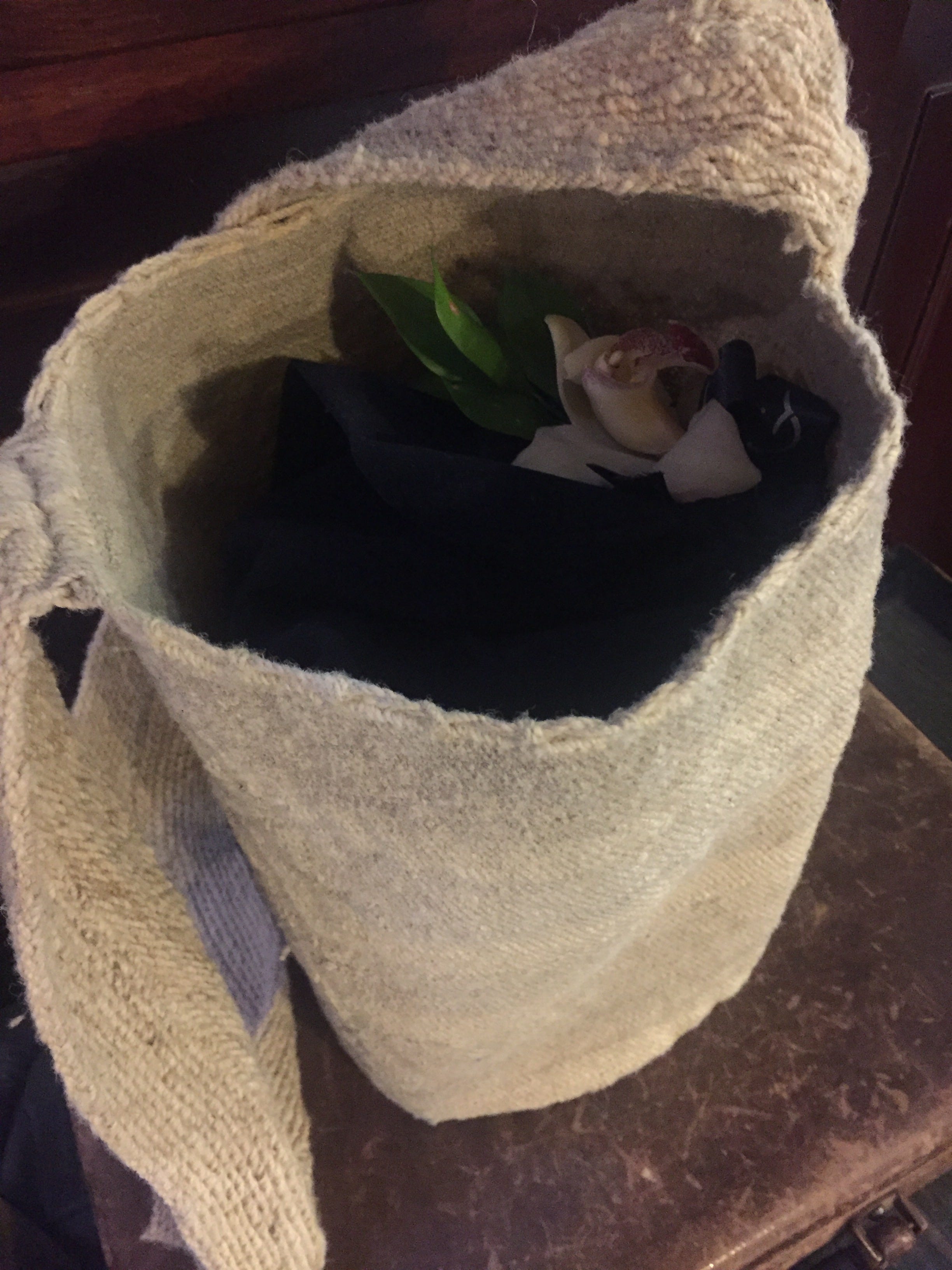
“You might be a day late, but you’ll get home,” I told her, told them, at the airport gate. “I came here with my father, who was giving a talk.”
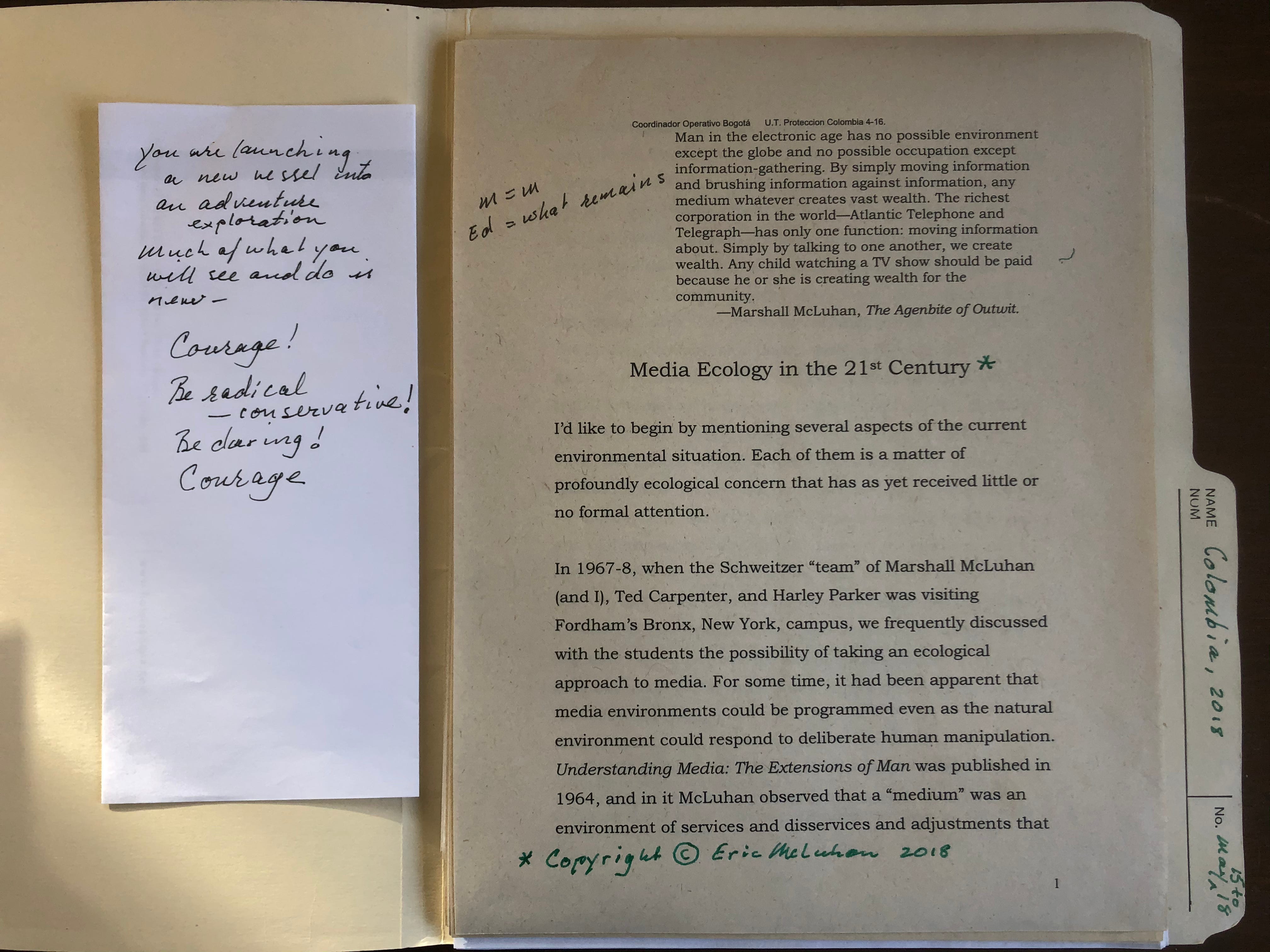
‘Media Ecology in the 21st Century’ delivered May 17, 2018, would be his last word on many matters.
“We were supposed to fly home together Friday.” It was Sunday evening now, turning into Monday. “Instead,” patting the bag resting on my lap, “I’m carrying home his ashes.” There was an understandably shocked silence. I think the woman beside me instantly (if only for an instant) forgot her troubles. “I’m sorry for what’s happened to you,” I told her, “truly. But you’ll catch another flight. You’ll be a bit delayed, but you’ll make it home.” There wasn’t much more to be said. It was a surreal moment. Even then it felt scripted, like a scene in a movie.
The previous summer, realizing that my father wouldn’t be around forever, slightly panicking that nothing was in place to keep things going, I came up with the basic idea for TMI, The McLuhan Institute. Nothing had been in place when my grandfather died on New Year’s Eve in 1980. The University of Toronto had (I want to say ‘gleefully’ but I wasn’t there, it’s just an impression I have) shut down his Centre for Culture and Technology, shutting him out, after his stroke had robbed him of speech. It reopened a few years later, and the building’s there, but he’s long gone. Few traces remain of him, to the disappointment of the occasional pilgrim who makes their way there, hoping to find him. They find a husk, take a photo, move on. What a shame.
Once upon a time I entertained the fantasy of one day becoming director of the Centre. Thankfully, I quickly found out that was never going to happen in any meaningful way, and so set out on my own.
(I have thought to put together the pieces remaining of the story of the closing of the Centre – I have a box of materials plus first-hand accounts – and I may do that sometime but it’s way down on the list of priorities. Come to it, it’s probably worth it to tell the story of the Centre from its dream to its establishment in the ‘Coach House’ to its closing (the university shut it down after McLuhan had a stroke, and used it as storage for a few years) to its reopening in the 80s to its present incarnation. It’s a pretty crazy story, with a few different versions. Ours has yet to be told. It’s a sad story really that probably does no one credit to tell, being most useful as a cautionary tale.)
But I digress.
I don’t think Eric, imo my father and Marshall’s intellectual and otherwise heir, was really keen on trying to take the (metaphorical or otherwise) helm. He was a scholar. The kind of person most happy left alone with his books and thoughts. He was the kind of scholar his father was – encyclopedic, ranging, brilliant, quick of pun and wit – but not the kind of … I don’t know the word exactly. Performer, maybe. Dad didn’t enjoy the stage and spotlight the way grandad did. The way I have and sometimes do. I was shocked when he confessed to me once how nervous he got before giving a speech – you wouldn’t have known it to see him present, he seemed so at ease, so natural.
I started The McLuhan Institute because nothing like it existed, and it needed to.
Needs to.
The notion had taken hold that my dad wouldn’t be around forever, and terrified me. I of course had no idea that forever would end before a year had passed. I had come up with these ideas for TMI while we were together in California (he gave a tetrad workshop at Facebook of all places, and gave a talk at the MEA convention that year) in the summer of 2017. He died in May 2018.
I built TMI on four pillars: research, education, archive, exploration. Honouring, maintaining the past while leveraging it for all it’s worth to help us in the present. This work had become, despite my best efforts, my passion. I had come to believe that the world needed to have access to what my family had been working on for generations, and I was determined that this work would not die with him, or with me. It wasn’t just me that inherited this legacy, it belonged to all humanity and it had become my task to make sure they got it. Some might call these ‘delusions of grandeur,’ but I’m going with them.
I feel I need to explain that the TMI task was self-appointed. No one asked me to do it, and I’m sure many would rather I didn’t. I myself didn’t want to do it until for whatever reason the work began to make sense to me and then I needed to know and do more. I didn’t come to this out of a sense of duty, it’s more that a sense of responsibility grew as my involvement grew. I was there, it fell to me.
I bombed horribly one time.
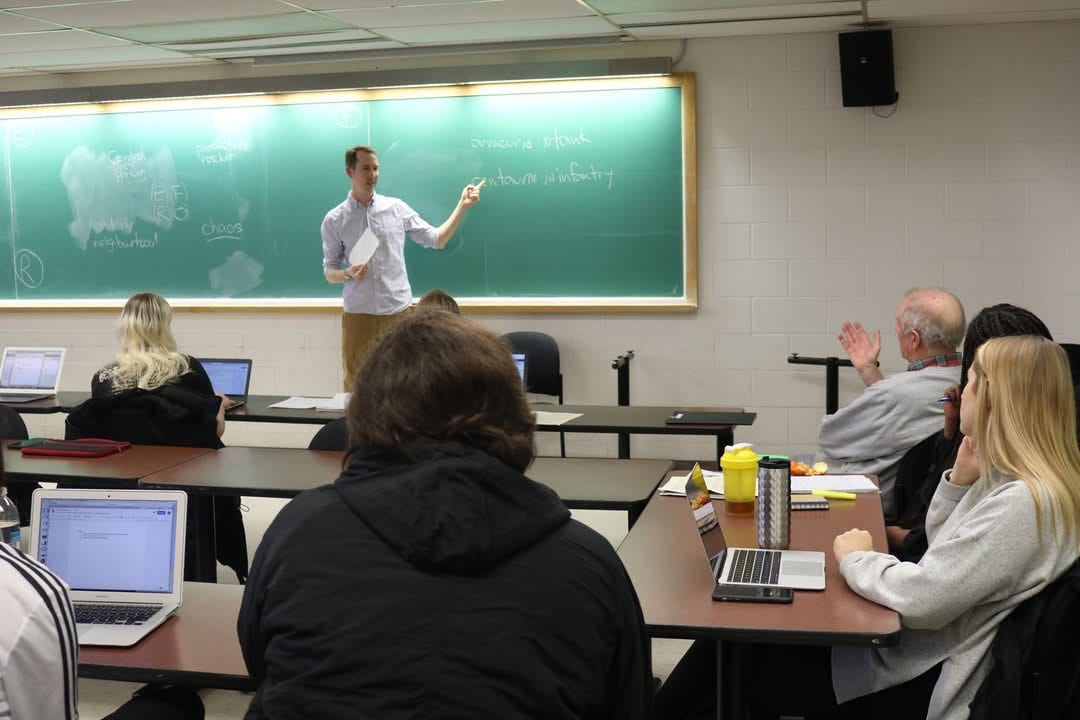
I’d been invited to guest lecture a class at Queen’s University in nearby Kingston, Ontario, and was so psyched. I’ve always been a sharesy type. I wanted to share EVERYTHING with them. I made the amateur’s error of trying to do too much and of course ended up doing next to nothing except embarrassing myself. But I did learn a very valuable lesson. Try to do too much, and you end up doing little to nothing. I found that it’s much better to try and get one thing across. And that can actually be a lot. (To be honest, I also committed the amateur’s error of fooling myself into thinking I knew or understood more than I did. I paid for that.) Anyway, if you’re going to fail, fail forward.
I swear I’m not retraumatizing myself on several levels without a point.
The idea of getting a single thing across, this spoke to the poet in me, always looking to compress, condense, distill, and it’s largely why I decided to focus on ‘the medium is the message’ when I started TMI: it’s really the most basic unit of understanding underlying media studies, certainly the McLuhan brand of it. I’ve found that if you can get one single thing across, that’s actually a lot. And I truly believe that this one thing, the understanding that it is the medium rather than the content which transforms us, is a world-changing idea, and the place to start. We can build from there.
Five words which could change our world.
A fundamental formula, poetic paradox.
The answer to so many questions.
It’s also already so out there in the world – the phrase, if not the knowledge. It seemed to me that with the phrase so seeded, half the job was done. I think I overestimated the amount of work done versus left to do there. Getting the world to understand that ‘the medium is the message’ is not so simple. Though I do feel it’s getting easier. In our time I can spend a while with people talking it over and they not only get it, it seems obvious. When Marshall first said it and for decades after, people thought he was nuts.
Some years ago, I decided to do a ‘the medium is the message’ workshop.
I talked to a friend of mine who ran a marketing business and I told him he should bring his team to it, and he challenged me to give him a good reason why his employees should attend.
I was at a bit of a loss at his question because it seemed so obvious to me, and yet I was struggling to come up with an answer. It seemed he was asking me “why study media?” and that seemed a ridiculous question. Obvious. And yet… I was having a hard time answering it.
I decided to see what other people had to say about it, so in 2015 I polled people.
Why study media?
The answers ranged from flippant
“because media study you!”
to philosophical
“to understand the human condition”
and from… whimsical
“A. Because that is ALL there is to study in the human realm.
A. Because I am not an ornithologist.
A. Because the water doesn’t taste as “fresh” as it used to, and we want to know why.
A. Because it is what we are already doing in our spare time, and figuring out how to receive a paycheck for it led us here.
A. Because it is the only thing students want or care to learn about these days.
A. Because it will help you understand History, Science, Math, Literature, Languages, Music, Geometry, Astronomy, Grammar, Logic, and Rhetoric.
A. It is like asking Why Have Ears? Because through the medium of sound we best understand all the other senses.
A. Because it is interesting and provocative, and makes a comedy out of the tragedy of history.
A. Because it is the only umbrella big enough - under which you can study anything else you want and still be doing Media Ecology.
A. Because Marshall McLuhan told us to...”
to theological
“I’m interested in media study because I know (as a Christian and as an actor), that what is not seen is more important, a lot more important, than what it is seen. And I am sure that I can’t understand the form of a visible rock without understanding the invisible wind that shaped it.”
I got a lot of replies. People were surprisingly game to try to answer that question. But I eventually realized that in the end it boiled down to one thing, and every different way I tried to ask the question, it was the perfect, if paradoxical, answer.
“A medium works on you much like a chiropractor or some other masseur and really works you over and doesn’t leave any part of you unaffected; it is a surround that is a process. It is not a wrapper. It is a process and it does things to you. The medium is what happens to you and that is the message.”
The Telegram (Toronto) volume 17, number 11, March 18, 1967
Why study media?
Because the medium is the message.
In loving memory of:
Dad. I can barely talk about this as it’s still, almost a decade later, so raw. It’s the cruelest irony that nothing I’ve done the last years would have been possible without him, nor would it have been possible with him. That’s hard to come to terms with. Luckily, he’s never far. Courage!
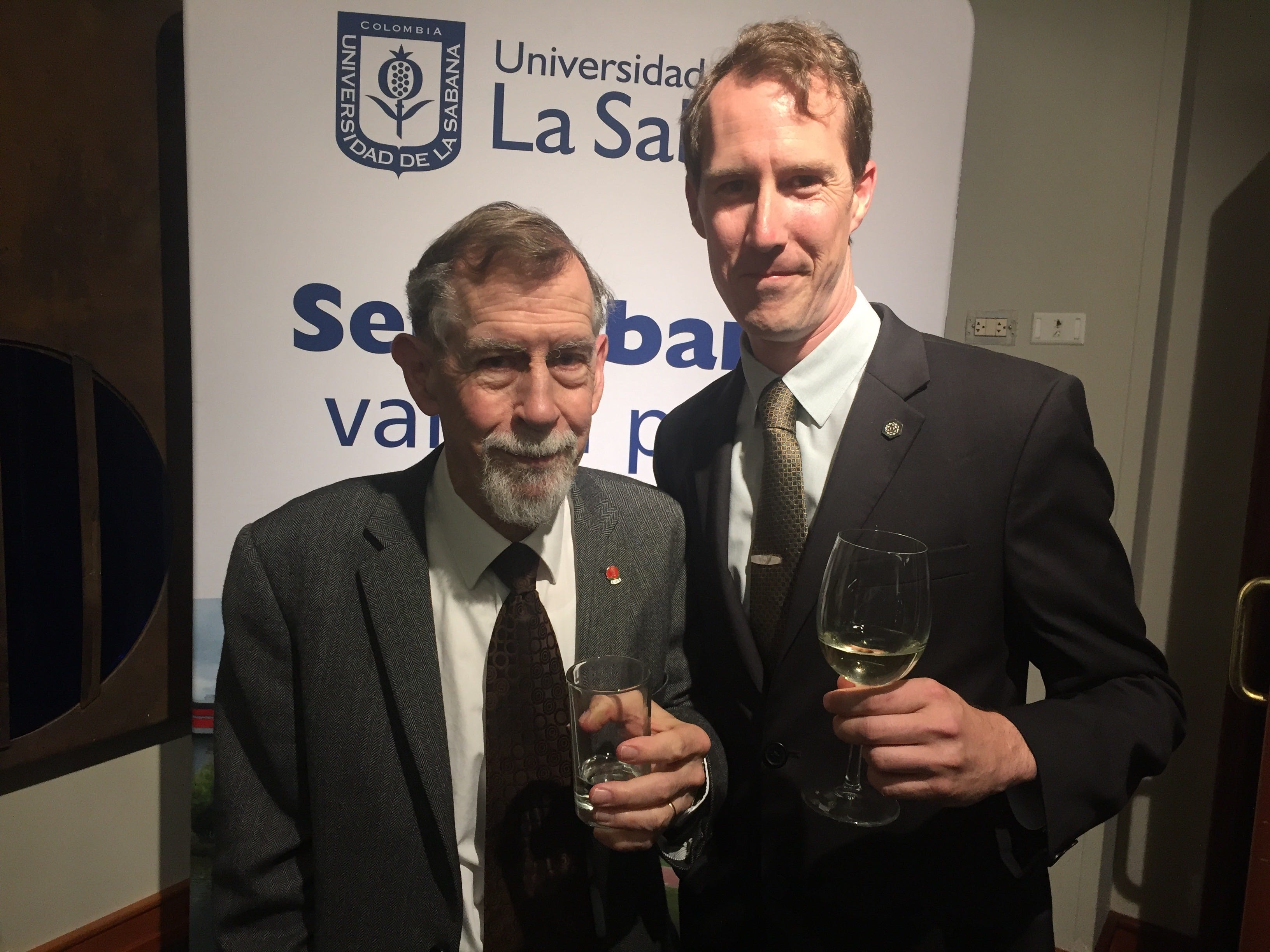
Sergio Roncallo Dow. Sergio was a punk rock philosopher, a rising star in Latin-American academia, a professor at the Universidad de la Sabana, a friend. He was the first person to find me at the hospital. I’ll never forget the look of concern, of anguish, as he rushed toward me down that hospital hallway. His illness and early death are deep tragedy.
Special thanks to:
Indeed I owe many debts at the Universidad de la Sabana, in Bogota. Manuel Gonzales, Angela Preciado Hoyos, Ana, Cordoba, Victor Garcia, Edward Goyeneche, Angelica Molinas, and more at the university and Canadian consulate. Forgive me for not naming everyone. In the aftermath of dad’s sudden death many people lifted me up and supported me. Their care and generosity were mighty. They took care of me, of everything that needed taking care of, sparing no effort or expense. I was alone but didn’t feel it. I cannot speak too highly of the Universidad de la Sabana and my friends in Bogota.
The many people, including those from the MEA listserve and elsewhere who entertained my questions and probings, and including subscribers of this newsletter, who have supported me efforts with TMI.
Chris Crawford for asking why.
Roel Vertegaal -- for inviting me to deliver a terrible guest lecture in his class, for coming to my rescue as I was losing the plot, but especially for agreeing to let me try again later, which went much better.
Luke Burgis – for your friendship and (involuntary? unintended?) mentorship, thank you. I so appreciate the courage of your example, and I hope you don’t mind I’ve borrowed a few things. The One and the Ninety-Nine is a rare book. What a gift to the world.
Stephen Jenkinson – too soon to say much more than thank you for trusting me to sit at your side this past weekend, to experience your incredible capacity for wordplay, to watch you courageously juggling wit and wisdom and storyline, to witness some Jesusing. Bless.
Special thanks to Ronika for always holding it down at home, for her miraculous ongoing support, and to Ezra and Virgil.
Shoutout to Chris Carmichael, Ahmad Iqbal, Jerome Jarre, for being there in the chat.
Big ups, of course, to all my haters. It’s like dad said about critics, “be grateful. No one works harder for you for less.”
Finally,
I wrote this (ok, typed it) while in a small cabin with a woodstove and a view through the pines of the river sometimes called the Bonnechere (thank you Kaz) (thank you Christou) near Killaloe. The inspiration was Luke’s introduction to his book I had received an advanced copy of. The way he fearlessly weaves the intensely personal into the subject matter, which is also intensely personal, gave me courage. I thought of it as a way to get into my book on ‘the medium is the message’ that I am determined to get done this year. But then I decided not to wait, to share it here and now, with you. Thank you.
Thanks for reading.
We’ve chatted before.
Frank Zingroni was my teacher (uncle Frank) and what a wonderful guy. I just wanna tell you again one of the funniest most enjoyable things that happened for me at York university is when your dad and Frank gave a joint lecture. It was brilliant, their learned brilliance was amazing: rapid fire and oh so funny. It was in one of the really big lecture halls, and there was probably 200 of us. They referenced getting in trouble previously for being too critical of the institution and feigned an apology which was a hilarious back-and-forth, they ticked the boxes of saying sorry and at the same time lambasted bureaucracy and melee mouth bureaucrats.
My buddy sitting next to me, Minoo, said something memorable; he looked at me and said , I see now that the pen really can be mightier than the sword.
They were my favourites. At minute 45 of the YouTube attachment your dad says it: the conservative person can be the most radical. They were both gentlemanly but loaded for bear, it was impressive the achievement of their intellects.
I’m in Prince Edward County - Milford - just around the corner from Bloomfield. One day I’ll reach out. Maybe we can say hello in person.